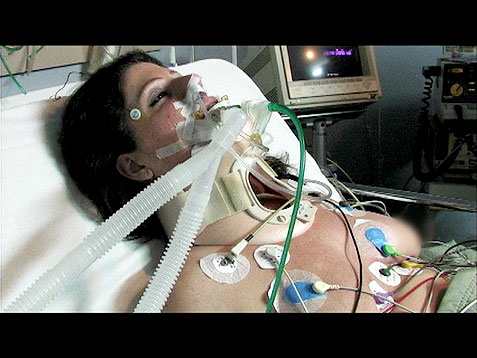
Hi there!
Today’s article is about, “Quick Tip for Families
in Intensive Care: What Steps Does My Dad Need to Take to Have His Tracheostomy Removed?”
You may also watch the video here on our website https://intensivecarehotline.com/blog/quick-tip-for-families-in-intensive-care-what-steps-does-my-dad-need-to-take-to-have-his-tracheostomy-removed/ or you can continue reading the article below.
Patrik: Hi, Jacquelyn, nice to meet you.
Jacquelyn: Hi, how are you doing?
Patrik: I’m pretty well, thank you. How are you?
Jacquelyn: I’m fine. I have a question for you. My father, 87 years old, was found unresponsive in the hospital.
They had him for observation. He had a cardiac arrest. They revived him, worked on him for 40 minutes. This happened May 25th. They ended up doing a tracheostomy. He’s in LTAC (long term acute care) now. He’s off the major ventilator, and they are doing physical therapy with him at LTAC, but he just hasn’t woken up.
He’s responsive to our voices and music and things like that. He’s not squeezing our hands anymore. Initially he was, but he’s not doing that now, and basically, I want to
bring him home. He’s a military veteran, so I want to bring him home, and just trying to make some decisions of basically, is that a good idea to do? Or should he go into rehab some more?
Patrik: Yeah. Jacquelyn, are they telling you he needs to leave LTAC in X number of days?
Jacquelyn: Oh, no, no, no, no, no. He’s been there a week now. He was at an ICU for a month, so he’s been at LTAC for a week now.
Patrik: I see, so it’s early days.
Jacquelyn: It is really early.
Patrik: Okay. And are you happy with the level of care he’s getting so far?
Jacquelyn: Yeah, so far. I went yesterday and he’s sitting. They had him sitting up in the chair, and they move, they turn him and yeah, so far, I have no complaints. I know you’re not into LTAC, but so far, I’m really surprised they’re doing pretty good.
Patrik: Look, Jacquelyn, I want to know if there’s a good LTAC because if there is a good LTAC, I will make recommendations. I just haven’t seen it. If there is a good LTAC, I will tell people about it. Just as I tell people about it if LTACs are not good.
Jacquelyn: Well, I’m in Georgia, so it’s part of Emory. Emory University, one of the
major hospitals here in Georgia. And so far, I have no complaints. We have no complaints. They’re doing physical therapy and they’re speaking, and they’re telling us that maybe he, as far as family, he would react more. And he seems to react more with family.
Patrik: Of course. Okay, that’s really good. So, when you say he’s had CPR (cardiopulmonary resuscitation) for 40 minutes,
obviously there is some brain injury from that?
Jacquelyn: Yes, they’re saying, that frontal area is pretty much really severely
damaged.
Patrik: Damaged, okay. And when you ask him to squeeze your hands, does he squeeze your hands?
Jacquelyn: No, not now. Before he had the tracheostomy and everything, ostomy, he was squeezing our hands, but now I see more or less his eyes. His eyes are moving,
and facial expressions.
Patrik: But you are more or less saying that his cognition isn’t as good as it was a few days, weeks ago?
Jacquelyn: Right. It’s different, because he was able to squeeze our hands before.
Patrik: And any ideas what might have changed?
Jacquelyn: No ideas.
Patrik: Okay. Do you know what medications he’s on?
Jacquelyn: They have him on regular, like his blood pressure medications. They stop the seizure medications. He was on that for maybe two weeks initially, but he’s not having any seizures anymore. Just his regular basic medications, nothing for seizures.
Patrik: Okay. But he stopped having seizures?
Jacquelyn: No, he is not having seizures at all.
Patrik: Good. Okay. Do they
have an answer why he might have stopped obeying commands, or following instructions? Have they got an answer for that?
Jacquelyn: They have said because of the frontal. The damage there in the frontal brain area. That’s what they have said, but they are still working on getting him to respond.
Patrik: Okay. When he’s getting out of bed, is his cognition better?
Jacquelyn: Yes, I did notice yesterday when they were shifting him, his eyes opened almost as though he was mad like, “What are you all doing to me?” His facial expression and his eyes. So, they stayed over for about five minutes, and it seems as though he recognized me, so
I just talked about daily things, and what’s been going on in the world. And he seemed to recognize me. And it was for five minutes.
Patrik: Okay, great.
Jacquelyn: And then he just closed his eyes, and I guess went back to his world.
Patrik: Right. How far away is he from having the tracheostomy removed? Are they
talking about that?
Jacquelyn: They have put the, what do they call it? It’s like the bubble. Part of the trach… It’s different weaning steps. They’ve taken him off the big machine, and now the oxygen is just blowing into it, and they’re looking at possibly maybe tapping it maybe in two weeks if he continues to do well, because he is basically breathing on his own.
Patrik: But he is already breathing on his own-
Jacquelyn: Right. He’s breathing.
Patrik: Okay. So, to come back, I haven’t forgotten about your original question,
whether you can take him home or not. I haven’t forgotten about that. I just tried to-
Jacquelyn: Okay. Okay.
Patrik: I just tried to get as much information as possible. So, Jacquelyn, here’s the thing, taking him home without a tracheostomy will be so much easier for
you. Taking him home with a tracheostomy will be very difficult for you without having 24-hour around the clock nursing care with someone that’s tracheostomy competent. The risk from my extensive
experience is too high.
Now, I would argue that your best-case scenario here is to have them remove the tracheostomy ideally, and it might take them another couple of weeks, but if that can be achieved, your life, half of your problems will be gone. Because if they can move it, he can manage his own airway. Whereas with a tracheostomy, someone needs to manage the airway, and you constantly
have to monitor the tracheostomy. You have to monitor for blockages. You might have to suction him. Do you know if he’s gotten inner tube, an inner cannula?
Jacquelyn: No, they’ve actually taken that out.
Patrik: Okay.
Jacquelyn: Because we’re just doing the regular suction from the inside of the mouth.
Patrik: Okay, so they’re not suctioning him through the tracheostomy.
Jacquelyn: No. No.
Patrik: Are you sure?
Jacquelyn: When I was there yesterday, let’s see. Yes, they are, they are. I try not to look at things, sometimes. But they are, because they cleaned around the area and… Yeah, they are.
Patrik: Okay. Well, let’s just quickly talk through Jacquelyn, what needs to happen to have the tracheostomy removed. The first thing that needs to happen is minimal suctioning. So, he needs to be able to clear his own airway. He needs to have a good, strong cough.
Jacquelyn: Okay. He’s been coughing.
Patrik: Okay, great. Great, okay. Because you got to picture this, once the tracheostomy is out, he needs to be able to bring up his own secretions.
Jacquelyn: Correct.
Patrik: If he
can’t bring up his own secretions, they will need to continue suctioning him.
Jacquelyn: Okay.
Patrik: Right. So that’s number one. Number two, have they done a swallow assessment?
Jacquelyn: Yes, they did attempt that with the ice chip, that was last week, and he didn’t swallow. That was last week. But this week, I don’t think they tried it this week.
Patrik: Okay. When you say he didn’t swallow, they put an ice chip in his mouth, and he was coughing?
Jacquelyn: Well, no, they put an ice chip in to see if he would swallow when it melted in his mouth.
Patrik: Yep. And what did he do? Did you see it yourself?
Jacquelyn: No, I didn’t see it myself, but that he didn’t
swallow that time, so they haven’t tried it again as of yet.
Patrik: Okay. All right. So, Number 1, he needs to cough, needs to protect his own airway. Number 2, he needs to be able to swallow. Number 3, have they tried a speaking valve?
Jacquelyn: No. The speaking
valve?
Patrik: Do you know what I’m talking about there?
Jacquelyn: No.
Patrik: Okay. So, for patients with a tracheostomy, eventually they should try a
speaking valve to see if he can talk.
Jacquelyn: Okay.
Patrik: Is he trying to talk?
Jacquelyn: I see more facial expressions and his mouth moving, so it’s
possible he’s trying to talk. I never thought about that, so okay. If he was trying to speak, we wouldn’t be able to hear it because of the…?
Patrik: Vocal cords would be paralyzed at the moment, because of the tube. However, do you know if he has the balloon, up? Do you know what I mean? The tracheostomy cuff? Do you know what I’m talking about?
Jacquelyn: Is that the… There’s a little blue thing that hangs out from-
Patrik: Yeah.
Jacquelyn: Okay.
Patrik: And in that little blue thing, they would be injecting a few mls of air to block the tracheostomy in the back of the throat.
Jacquelyn: Okay.
Patrik: Now if you give me one second, I’ll get a tracheostomy and I’ll show it to you here. Just give me one second please.
Jacquelyn: Okay, thank you.
Patrik: I will show it to you here so you can actually understand what I’m talking about, because these are all important things for you to understand what needs to happen to have the tracheostomy removed. Now just give me one second. So, can you see that?
Jacquelyn: Yes.
Patrik: So that’s a tracheostomy tube obviously. So, hang on, I’ll just show you so that you can see what’s happening here. So, you can see that little… Hang on. There we go. Now I’m injecting air. Can you see that balloon going up?
Jacquelyn: Yes.
Patrik: So, if that balloon is up, most likely your dad can’t swallow. Most likely. Because that balloon stops saliva from going into the lungs.
Jacquelyn: Okay.
Patrik: So, you
should check with them if he’s got a tracheostomy with that balloon. I’d say most likely he does. On some occasions, patients might have a tracheostomy without a balloon, but that’s very rare. It’s really only for patients that only need the tracheostomy for suctioning. They can swallow, but they need the tracheostomy for suctioning, because they can’t bring up their secretions. Knowing what you’ve shared about your dad, I argue he does have a blocked tracheostomy. Most likely.
Jacquelyn: Probably more than likely.
Patrik: So, what they need to do as a next step, they should be taking the balloon down, put up a speaking valve. The speaking valve won’t work without the balloon down, because the balloon is basically what paralyses the vocal
cords.
Jacquelyn: The vocal cords. Okay. Thank you for that.
Patrik: Okay, again, let’s just keep moving, in terms of when to take out the tracheostomy. He needs to cough, he needs to be able to swallow, the balloon needs to be down. It would be good if he can talk. It’s not necessarily a prerequisite that people need to talk in order to take the tracheostomy tube out, but it would help, of course. Once all of that is done, then they should cap the tracheostomy. So, capping the tracheostomy means… Again, I can show you that
here. If you give me another second. So, this is the front of a tracheostomy. I think you can see that.
Jacquelyn: Yeah, I see it.
Patrik: So, when they’re capping it, they put in a little guide wire, and then they block it like this. Can you see that? I put the block
in, and then once the block is in, he should be able to breathe either through the nose or the mouth.
Jacquelyn: Mouth. Okay, thank you.
Patrik: If he ticks all of those boxes, they should be able to take the tracheostomy tube out.
Jacquelyn: Okay. Thank you. Thank you.
Patrik: You’re welcome. You’re welcome. And then to answer your question, can you take him home? Like I said, I would not take your dad home without having 24-hour nursing care with a tracheostomy.
Jacquelyn: With the tracheostomy. Okay.
Patrik: If he has the tracheostomy removed, he probably still needs some care, but the airway is most vulnerable with the tracheostomy. If that tracheostomy blocks at home and you don’t know what to do, you basically have three minutes to protect that airway.
Jacquelyn: Okay. That’s true.
Patrik: So, your best way forward here, I believe with what you’ve shared with me, is to ask them to move him towards a tracheostomy decannulation as quickly as possible.
Jacquelyn: Correct. Yeah, that’s something me and my brothers were
talking about. That would be the best scenario to have that completely blocked for him.
Patrik: Completely removed. Completely removed.
Jacquelyn: Completely removed.
Patrik: Then you don’t need to worry about the airway. Does he have a PEG tube?
Jacquelyn:
Yes, he does have the PEG tube (percutaneous endoscopic gastrostomy), yes.
Patrik: Okay. So, then you wouldn’t have to worry, at least in the beginning, you wouldn’t have to worry about feeding him. You can just use the PEG tube. Again, ideally, once the tracheostomy tube is out, and hopefully he can swallow, ideally you can get him back to eat and drink, but they need to do the
swallow test-
Jacquelyn: Of course, first swallow test. Right.
Patrik: And then go from there. Now, when he’s getting out of bed, are they using a lifting machine, or what are they doing?
Jacquelyn: Yes, they’re using it, is it pronounced the Hoyer lift? H-O-Y something?
Patrik: Yeah, it’s a Hoyer lift.
Jacquelyn: Hoyer lift, yes. Yes, that’s what they’re using.
Patrik: Okay. You will probably need similar devices at home, whether he has a tracheostomy or he doesn’t. Because if you do it yourself or your family, or even if you employ people, even if you have home healthcare coming in, you don’t want people to end up with a back injury.
Jacquelyn: Back problem. Right. Okay.
I thank you so much for speaking with me and help me figure out this situation.
Patrik: It’s a great pleasure. And just anticipating what’s going to come, because I’ve seen it so many times, Jacquelyn. I anticipate if things are not moving as quickly as you would like, as they would like, usually when it comes to the Day 30 mark, they want to send him to a SNF, to a Skilled Nursing
Facility. I can almost anticipate that. Now, if he’s making progress and if he’s making strides to moving away from the tracheostomy and hopefully, they can decannulate him, I wouldn’t go anywhere until he has the tracheostomy removed, and then you can hopefully take him home.
Jacquelyn: Right. Yeah, that’s correct.
Patrik: Because if he does end up going to a Skilled Nursing Facility, the level of care there is even worse.
Jacquelyn: Yes, it is.
Patrik: I am pleased to hear that you have found a good LTAC. I’m very pleased. I’m
very pleased that… If they can take the tracheostomy out and you can take your dad, that would be amazing.
Jacquelyn: Yes, yes, yes. That’s one of the reasons I actually researched myself and pushed for them to send him to this particular place actually. Because they were trying to send him hours away, that doesn’t make any sense to send a patient hours away from
family.
Patrik: It doesn’t. It doesn’t, does it?
Jacquelyn: Yeah.
Patrik: Is the LTAC close to home?
Jacquelyn: Yes. It’s just 30 minutes from where I am, so it’s very convenient. I can pop up
anytime.
Patrik: That’s good. That is very important. That is very important-
Jacquelyn: It is very important.
Patrik: For family, your family can be
around.
Jacquelyn: Right. When you have a loved one in a situation where someone else is taking care of them, it’s good to be able to pop up without anyone knowing when you’re coming, just to make sure things are flowing like they should.
Patrik: You keep them on their
toes.
Jacquelyn: Yes. Yes.
Patrik: Good idea.
Jacquelyn: Thank you. I know there are other people that want to talk to you, but I thank you so
much.
Patrik: It’s a great pleasure. Nice to talk to you, Jacquelyn. Take care.
Jacquelyn: Nice to talk to you. Thank you. You too.
Patrik: Thank you.
Bye.