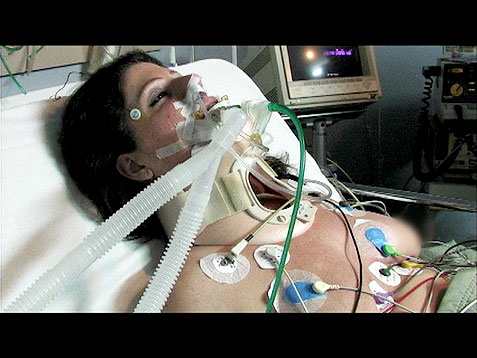
Quick Tip for Families in Intensive Care: My Brother Gets Exhausted When Breathing Spontaneously with Tracheostomy, Can He Go Back on CPAP (Continuous Positive Airway Pressure)/PS (Pressure
Support)?
Hi, it’s Patrik Hutzel from intensivecarehotline.com with another quick tip for families in intensive care.
So today, I have an email from Victoria who says,
“Hi Patrik,
My brother is on a ventilator and was breathing on his own for 5 hours and then he became tachypneic. Could I consider putting him back on a ventilator or CPAP support? Thank you so much.” Now, Victoria is a client we worked with over the last few months. So, I know the story of her brother and the situation of her brother.
So, here is what happens in a situation like that. I know her brother has a tracheostomy and has been weaning off the ventilator on and off over the last few weeks in any case.
So, what she’s referring to here is that her brother has been on a tracheostomy collar with
tracheostomy shield. Basically, he has been disconnected from the ventilator and then breathes by himself just with some humidified air or humidified oxygen. Then, he gets exhausted after about 5 hours and that is nothing uncommon when someone is being weaned off a
ventilator.
So, here is what should happen in a situation like that, it is a very relevant question. This is super relevant question in a situation like that as a matter of fact and given that the
biggest challenge for families in intensive care is that they don’t know what they don’t know. They don’t know what to look for. They don’t know what questions to ask. They don’t know their rights and they don’t know how to manage doctors and nurses in intensive care.
Victoria has done her research, and she has watched all my
videos and read all the blogs and questions answered. So, she’s coming from an informed place, which is really good.
So, when your family member gets exhausted after about 5,6 hours of breathing spontaneously, if they have a tracheostomy, in most cases, you can put them back on CPAP (Continuous Positive Airway Pressure) or pressure support in most cases.
So, what is CPAP or pressure support? It means that, just breathing on one level of pressure, it’s often a PEEP (Positive End-Expiratory Pressure) of 5, but it can also be a PEEP of 7, or maybe 8, or 7.5 and a little bit of pressure support may be anywhere between 5 and 10 is often the case, but it can be higher as well.
Then it
depends, is the breathing rate slowing down? Is the breathing rate normal? Normal breathing rate is around 8 to 30 breaths per minute? Are the volumes okay when your loved one goes back on the ventilator? The breathing volume should be around 7 to 10 mls per kilo. So, for simplicity, if your loved one is 80 kilo times 10, that should be 800 mls roughly. All right, once again, 7 to 10 mls per kilo.
Next, if all of that is in place, what is oxygen saturation like? Is it above 95%, 96%? What are arterial blood gases like? Are they within normal limits? How often does your loved one need suctioning? Do they need suctioning every 5
minutes or do they only need suctioning every few hours? How comfortable do they feel on the pressure support or CPAP?
Now, if going from spontaneously breathing to CPAP is still not making your family member comfortable, they’re still exhausted, they’re still breathing fast breathing shallow, their oxygen saturation is low, is it an oxygenation issue? Do you need to increase oxygen levels, for
example?
But if that’s not the case, then you might need to change to a controlled ventilation mode such as CMV (Continuous Mandatory Ventilation), SIMV (Synchronized Intermittent Mandatory Ventilation), for example, CMV or SIMV I should say because that gives a baseline for your loved one. It means they can breathe with a minimum rate from the ventilator. That means they get a guaranteed rate from
the ventilator, 12,20 breaths per minute and they can breathe on top of that if need be. Whereas on CPAP or pressure support, they need to trigger every single breath themselves.
Weaning off the ventilator is often a marathon, not a sprint. What is also critically important, what Victoria hasn’t said in her email, is mobilization. I have not seen many patients being successfully weaned off the
ventilator without mobilization, meaning patients need to get out of bed. Before you’re telling me now, “Oh no, they can’t do that.” I’m telling you they can.
There are only three things that stop patients from being mobilized when on a ventilator. The first thing is if someone is hemodynamically unstable, their blood pressure is up or down, heart rate is up or down, or they have fractures. They might be waiting for surgery, they have fractures. Number three, which is probably the biggest thing that stops people from being mobilized is mindset. Mindset (laziness and being complacent). That is what stops people
from being mobilized.
I have not seen people being weaned off the ventilator successfully without mobilization. Most ICUs that I worked at and I worked in ICU and in critical care for nearly 25 years in three different countries where I worked as a nurse manager for over 5 years. I’ve been consulting and advocating for families in intensive care all around the world here at
intensivecarehotline.com since 2013.
We’ve been saving many lives with our consulting advocacy. You can verify that on our testimonial section at
intensivecarehotline.com or on our podcast section where we’ve done video interviews with our clients.
So, once again, three things stop people from being mobilized in the ICU
when weaning off the ventilator, number one is hemodynamic instability. Number two is fractures. Number three is mindset (laziness, and complacency). Nothing else. So, if the ICU is saying, “Oh, we don’t do that here. We can’t do that here.” Well, they can. They can, it’s just a mindset issue. So, you need to push for that regardless.
So, the question from Victoria to a degree is incomplete because
yes, you can do all of what I just elaborated here. CPAP, pressure support, SIMV, CMV, but there’s a one incredibly important ingredient missing which is mobilization. It’s 50% of the equation.
Don’t let intensive care teams making excuses or for our U.S. audience, if you are in LTAC (Long Term Acute Care) in the U.S., don’t let them make excuses and say they can’t be mobilizing their loved one. It’s nonsense. Absolute nonsense. As soon as you can get a patient out of bed, you should get them out of bed.
Think about it, for anyone who’s doing sports or whatever, you can’t run a marathon if you’re not training for it. It’s the same with weaning off the ventilator. You need to train for it, you need to prepare for it, you need to do the exercises. It’s not going to happen otherwise. So, I hope that helps and explains how your loved one can master that situation.
Now, because we get so many questions for families in intensive care or from families in intensive care, that’s why we created a membership for families of critically ill patients in intensive care. You can become a member if you go to intensivecarehotline.com if you’re clicking on the
membership link or you go to intensivecaresupport.org directly. In the membership, you have access to me and my team, 24 hours a day, in the membership area and via email and we answer all questions, intensive care related.
In the membership, you also have exclusive access to 21 e-books and 21 videos that I have personally written and
recorded, and those e-books and videos will help you to manage and steer this incredibly difficult environment that is intensive care. It will help you to make informed decisions, have peace of mind, control, power, and influence, making sure your loved one gets best care and treatment.
I also offer one-on-one consulting advocacy over the phone, Skype, Zoom, WhatsApp, whichever medium works best for you. I talk to you and your families directly. I handhold you through this experience that is intensive care that I have decades worth of experience in. I also talk to doctors and nurses directly. I ask all
the questions to the doctors and nurses that you haven’t even considered asking but must be asked when you have a loved one in intensive care and it will help you make informed decisions, have peace of mind, control, power, and influence, once again, making sure your loved one gets best care and treatment. Once I start talking to doctors and nurses directly, you will see that the dynamics will change in your favor because they know you have someone on your team who understands intensive care
inside out. I also represent you in family meetings with intensive care teams.
We also offer medical record reviews in real time so that you can get a second opinion
in real time. We also offer medical record reviews after intensive care if you have unanswered questions, if you need closure, or if you are simply suspecting medical negligence.
All of that, you get at intensivecarehotline.com. Call us on one of the numbers on the top of our website or send us an email to support@intensivecarehotline.com.
If you like my videos, subscribe to my YouTube channel for regular updates for families in intensive care, click the like button, click the notification bell, comment below what you want to see next,
what questions and insights you have, share the video with your friends and families.
I also do a weekly YouTube live where I answer your questions live on a show and you get notification for that if you subscribe to my YouTube channel or if you are an email newsletter, subscriber at intensivecarehotline.com.
Thank you so much for watching.
This is Patrik Hutzel from intensivecarehotline.com and I will talk to you in a few days.
Take care for now.